
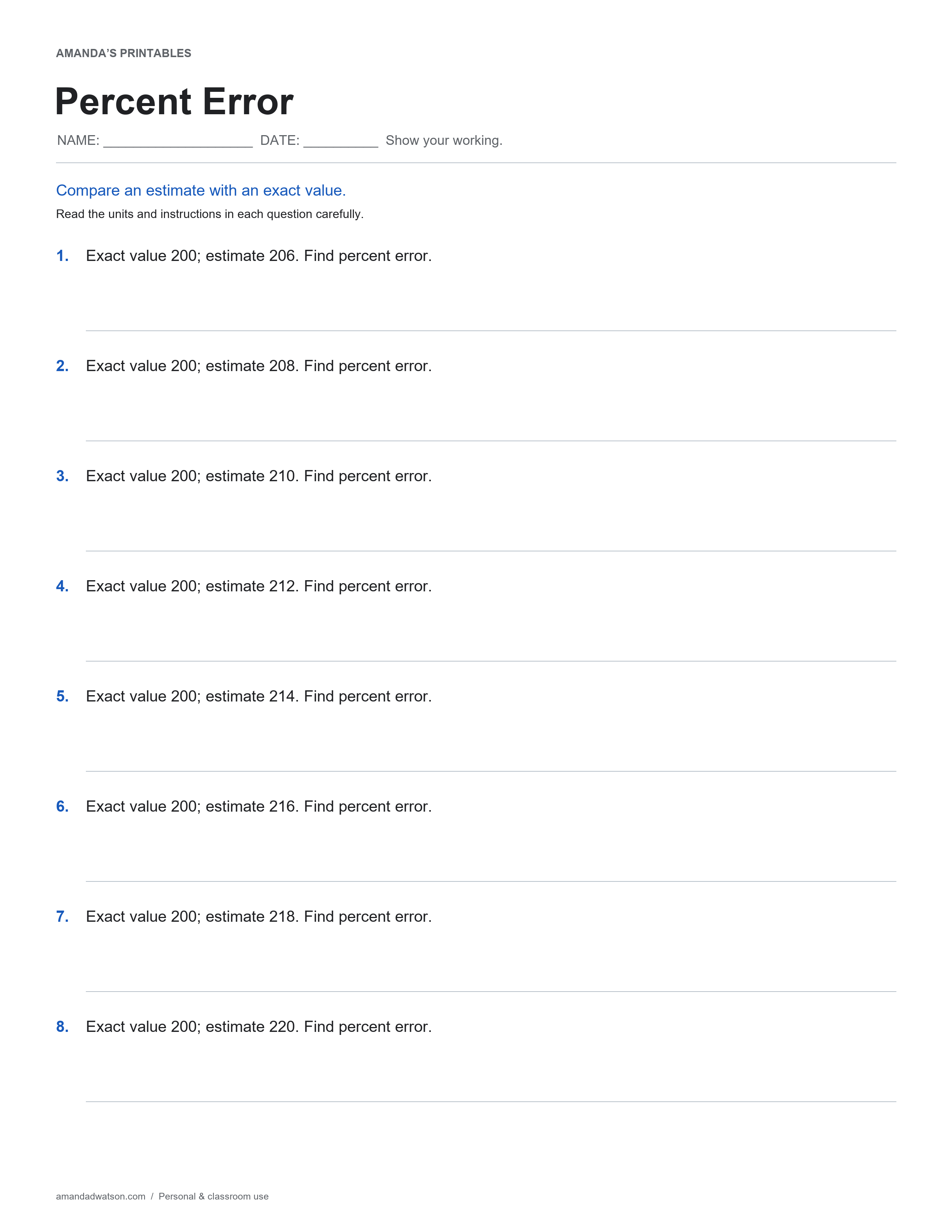
Compare an estimate with an exact value with this free percent error worksheet. The practice page contains eight numbered questions, with a separate answer page so learners can attempt the work before checking. It is designed for focused practice after the underlying idea has been introduced, rather than as a timed test or a placement assessment.
How to work through the questions
Use absolute difference divided by the exact value, multiplied by 100. These exact values are nonzero. Begin by identifying the information supplied and the quantity you need to find. Write at least one intermediate step beside each question; the working is often more useful than a final answer when you are deciding what to review.
A first-question check
The first prompt is: Exact value 200; estimate 206. Find percent error. The checked result is 3%. Use the method above to explain how the given information leads to that result. Then cover the key and solve the remaining questions independently.
What to watch for
The denominator is the exact value. Absolute difference makes the reported error nonnegative. If an answer differs from the key, compare one step at a time. Mark whether the issue came from reading the prompt, choosing an operation, calculating, or writing the units. Correct that step and retry the question without copying the answer.
Questions in text
- Exact value 200; estimate 206. Find percent error.
- Exact value 200; estimate 208. Find percent error.
- Exact value 200; estimate 210. Find percent error.
- Exact value 200; estimate 212. Find percent error.
- Exact value 200; estimate 214. Find percent error.
- Exact value 200; estimate 216. Find percent error.
- Exact value 200; estimate 218. Find percent error.
- Exact value 200; estimate 220. Find percent error.
Answer key
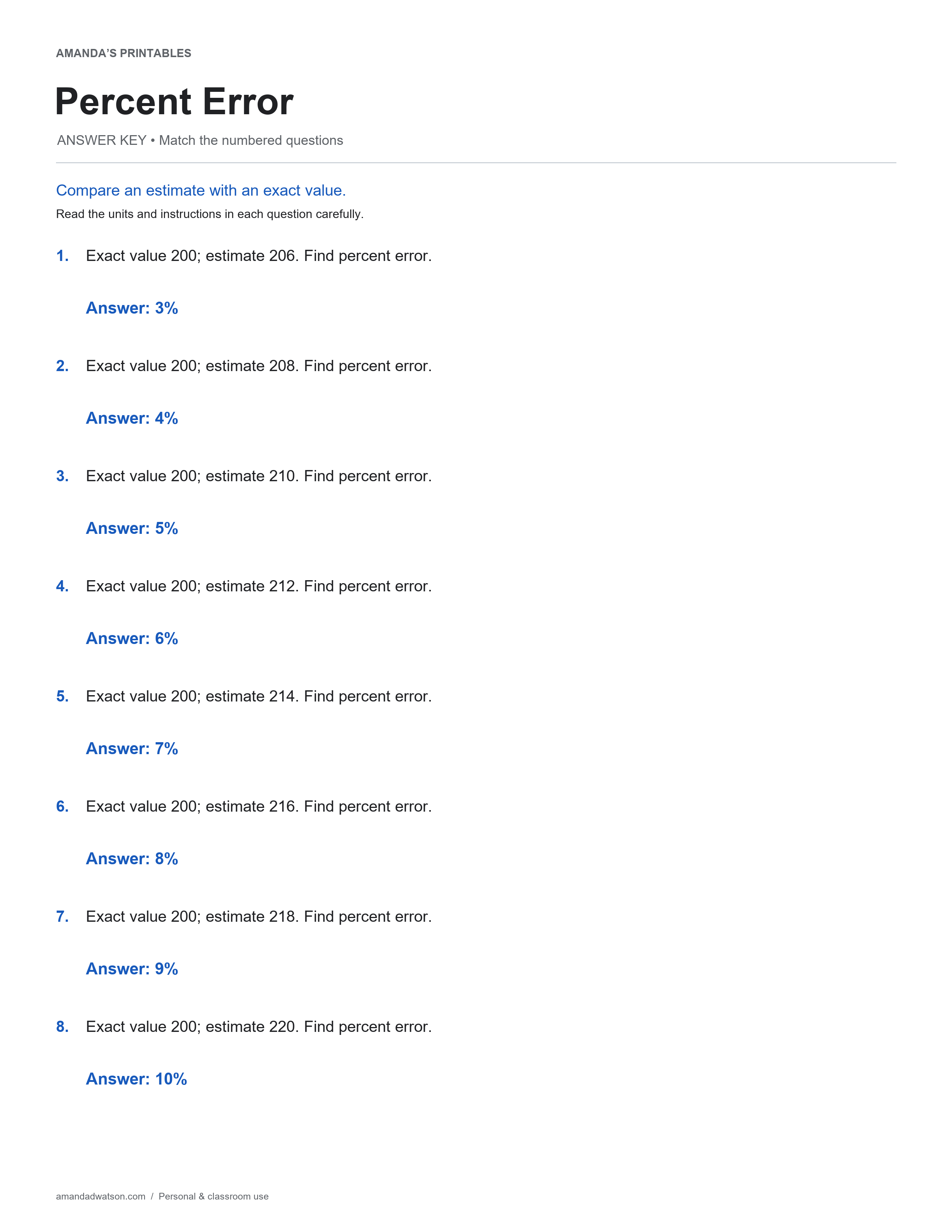
- 3%
- 4%
- 5%
- 6%
- 7%
- 8%
- 9%
- 10%
Download and print
Use Download image beneath either page to save its original 2550 × 3300 PNG. For a PDF, choose US Letter or A4 in that page’s controls and select Download PDF; the theme creates the file in your browser. Match the printer paper size, keep uniform scaling and check the margins in print preview. Print a test copy before making a classroom set. Keep the answer sheet separate during independent practice. These original worksheets are for personal and classroom use; share this article link when recommending them.