
What this printable helps you do
Distinguish documentary claims from the evidence presented on screen. Keep enough source information to find the original item again. Use a title, date and relevant timestamp or page reference where available. Your own summary should be visibly different from a short direct quotation. The organizer helps you ask better questions; completing a box does not by itself establish that a source or claim is reliable.
What is on the page
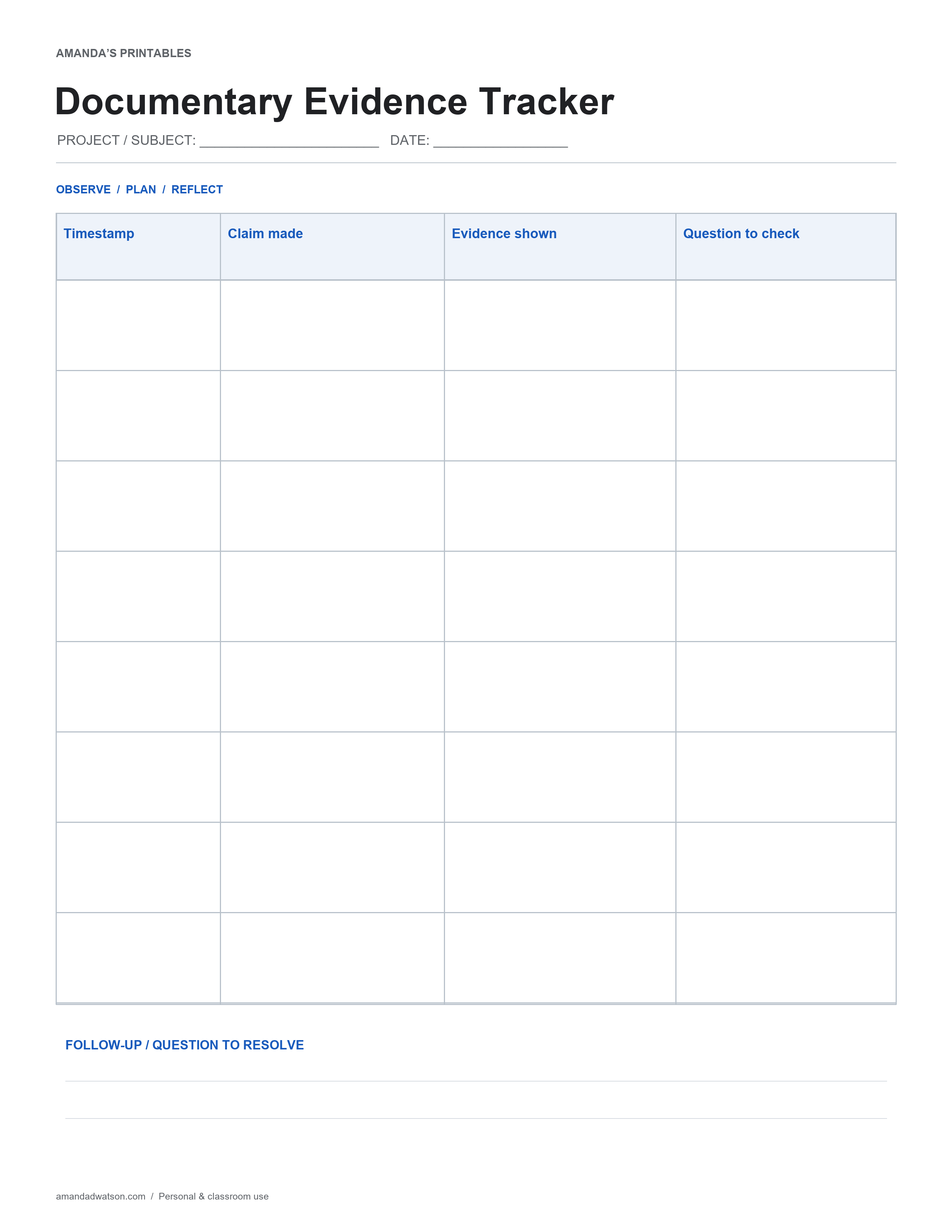
The page uses a spacious four-column log with room for repeated entries and a follow-up area below. Keep one observation or item on each row so information stays connected across the columns. The four headings are Timestamp, Claim made, Evidence shown, Question to check. Add a subject identifier and date at the top so the page can be understood when you return to it.
How to use it
Pause at a relevant moment and describe whether support is an interview, document or image. Start with one example rather than filling the whole page at once. Use ordinary language you will understand later and add a reference where a note depends on another source.
A practical example
A narrator statement and an archive photograph may concern different dates; note the distinction. This illustrates how to begin; the downloadable page is blank so you can use your own subject, materials and observations.
Review before you reuse it
Look for missing context and avoid treating confident narration as proof. Read the finished page from the perspective of someone who was not present. Clarify an abbreviation, mark an unanswered question and identify the next small action if one is needed.
Download and print
Use Download image beneath the printable to save the original 2550 × 3300 PNG. Select US Letter or A4 and choose Download PDF to create a flat one-page PDF in your browser. Match the printer paper setting and use uniform scaling so the page stays in proportion. Check the title and bottom writing areas in print preview, then make one test copy before printing a set. This is a handwriting resource, not a fillable form or an editable spreadsheet. Original pages are for personal and classroom use; share the article link when recommending the resource.