
What this printable helps you do
Organize which family records will be digitized next. Keep sources and uncertainty visible. Preserve the distinction between what is documented, what someone remembers and what remains to be checked.
What is on the page
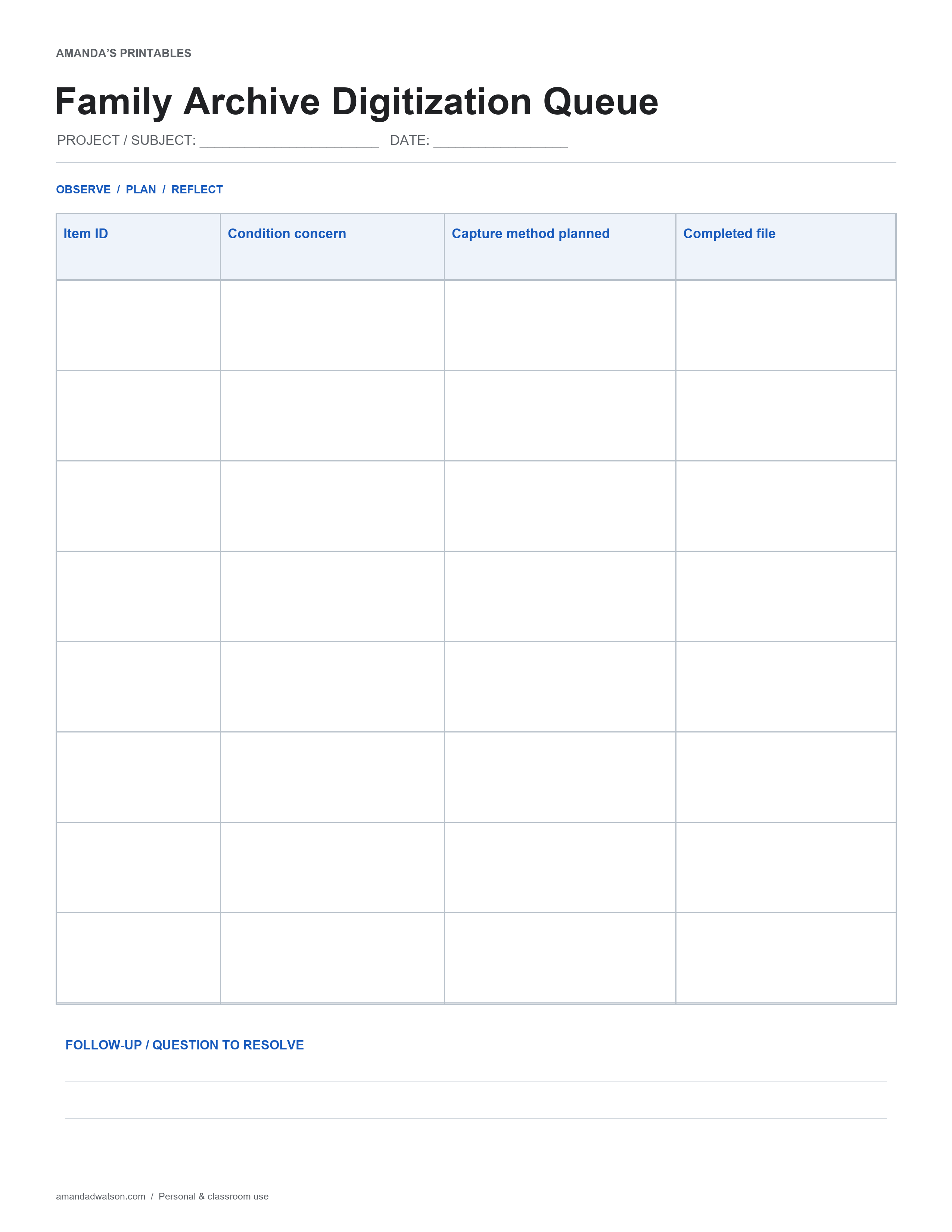
The page uses a spacious four-column log with room for repeated entries and a follow-up area below. Keep one observation or item on each row so information stays connected across the columns. The four headings are Item ID, Condition concern, Capture method planned, Completed file. Add a subject identifier and date at the top so the page can be understood when you return to it.
How to use it
Prioritize items according to your project and get preservation advice for fragile originals. Start with one example rather than filling the whole page at once. Use ordinary language you will understand later and add a reference where a note depends on another source.
A practical example
A folded letter may need careful handling before a scan can be planned. This illustrates how to begin; the downloadable page is blank so you can use your own subject, materials and observations.
Review before you reuse it
Do not force fragile bindings or use an untested cleaning method to improve a scan. Read the finished page from the perspective of someone who was not present. Clarify an abbreviation, mark an unanswered question and identify the next small action if one is needed.
Download and print
Use Download image beneath the printable to save the original 2550 × 3300 PNG. Select US Letter or A4 and choose Download PDF to create a flat one-page PDF in your browser. Match the printer paper setting and use uniform scaling so the page stays in proportion. Check the title and bottom writing areas in print preview, then make one test copy before printing a set. This is a handwriting resource, not a fillable form or an editable spreadsheet. Original pages are for personal and classroom use; share the article link when recommending the resource.