
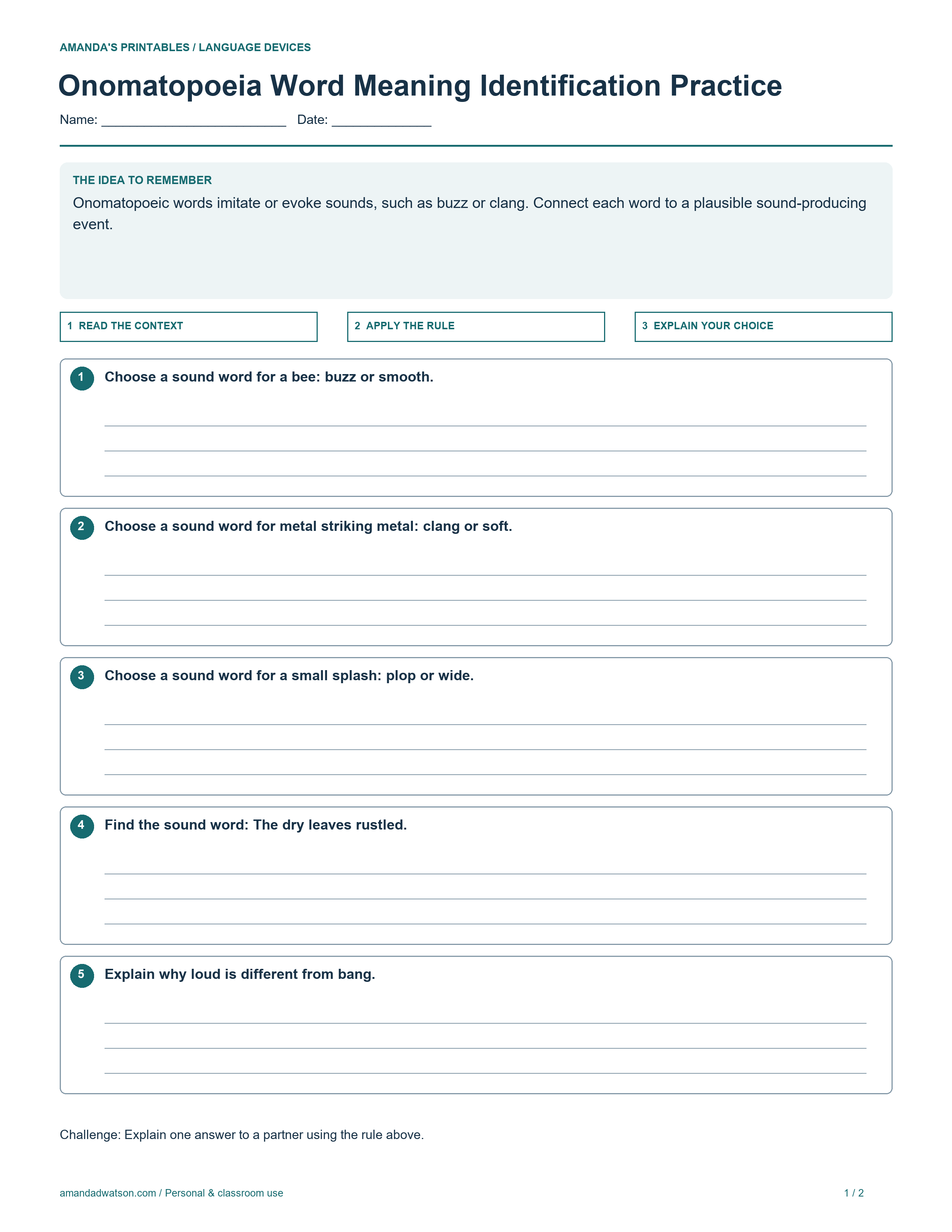
Free Onomatopoeia Word Meaning Identification Practice Worksheet provides five focused questions and a separate answer sheet for home or classroom practice. The onomatopoeia worksheet with answers begins with a short rule reminder, then asks learners to apply that idea and explain a choice. Both pages are free to download as original printable images.
What is included
- A student page with the rule, five questions and space to write.
- A separate key with answers, explanations and sample responses.
- Text versions of every question and answer below for reference.
Understand the skill
Onomatopoeic words imitate or evoke sounds, such as buzz or clang. Connect each word to a plausible sound-producing event.
Use the page for sound imitation words practice after introducing the idea aloud. Learners should be able to read the short sentences or work with a reader who can read them aloud. This is focused practice, not a complete course or a standardized assessment.
Teach the first example
Read this prompt together: Choose a sound word for a bee: buzz or smooth. The key gives this response: buzz. Ask the learner to connect that response to the rule before moving on. Cover the answer page during the remaining questions so it supports checking rather than copying.
Try the five questions
- Choose a sound word for a bee: buzz or smooth.
- Choose a sound word for metal striking metal: clang or soft.
- Choose a sound word for a small splash: plop or wide.
- Find the sound word: The dry leaves rustled.
- Explain why loud is different from bang.
A mistake worth discussing
A word describing loudness is not necessarily an imitation of the sound itself.
If a response seems uncertain, return to the exact words in the prompt. Ask what evidence supports the answer. For a correction, read the original and revised sentence aloud and describe what changed. A learner who can explain a choice has shown more than recognition of a familiar pattern.
Answer key and explanations
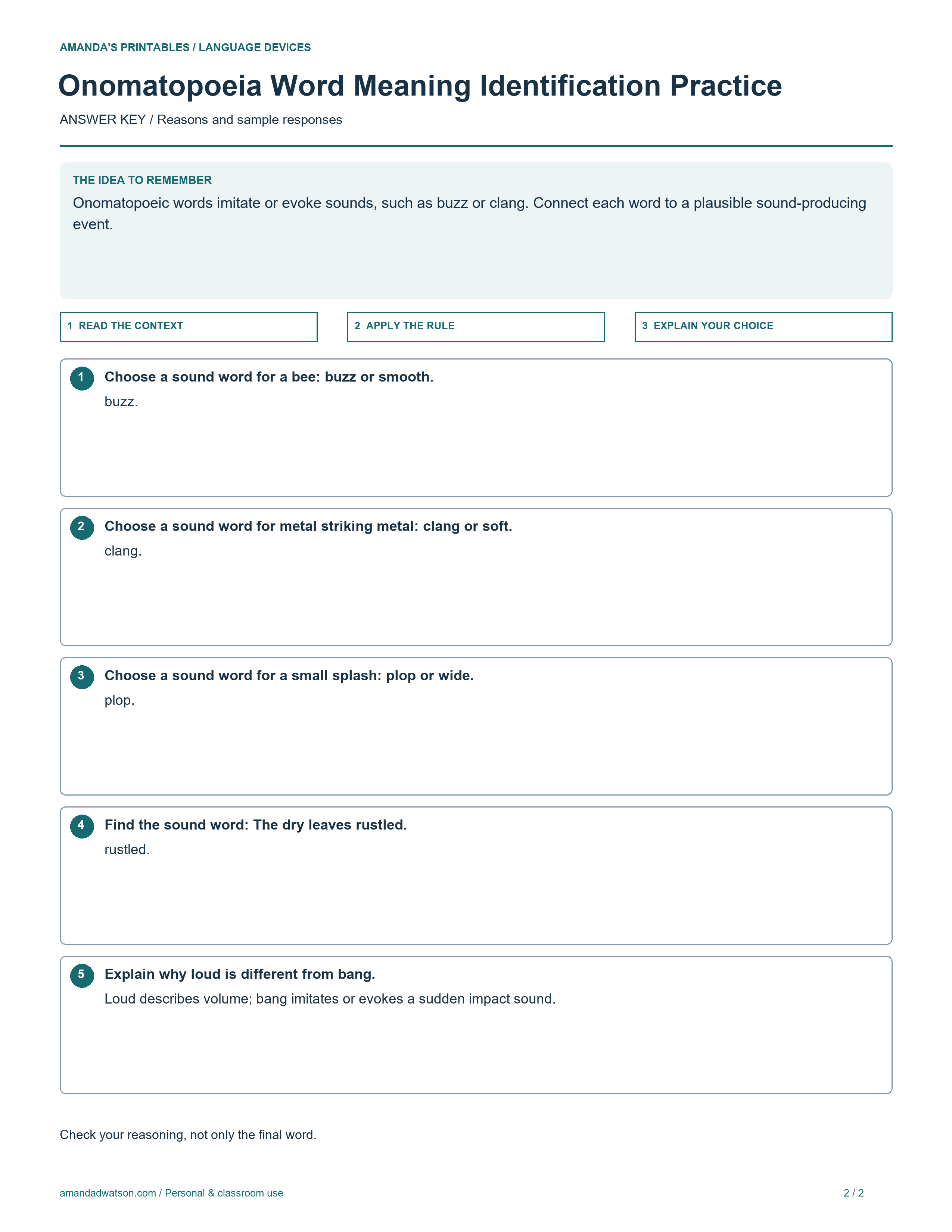
- buzz.
- clang.
- plop.
- rustled.
- Loud describes volume; bang imitates or evokes a sudden impact sound.
Where a prompt asks for an original sentence or explanation, the key gives a sample rather than the only possible wording. Accept other responses that meet the instruction and demonstrate the same idea. Spelling and punctuation can be discussed separately when they are not the main skill being practiced.
Download and print
Use Download image below either preview to save its original 2550 × 3300 PNG. For a PDF, select US Letter or A4 and choose Download PDF; the site creates that page in your browser. Print the student sheet and key separately, use uniform scaling and check the page edges in print preview. The pages are flat resources for handwriting, not fillable or editable documents. Personal and classroom use is welcome; share the article link rather than redistributing the files.