
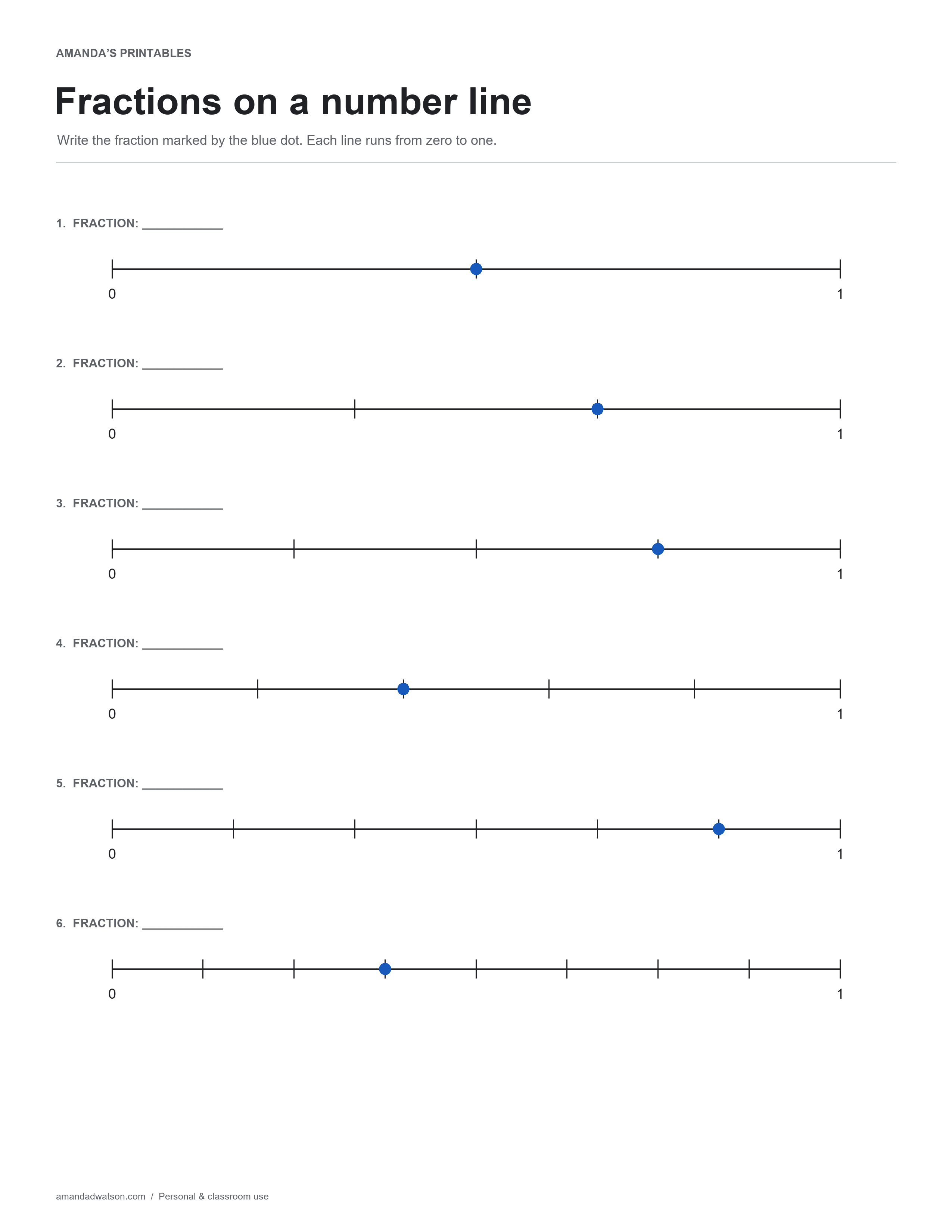
This fraction number line worksheet shows six lines from zero to one, each divided into equal intervals. A blue dot marks one point on each line. Write the fraction represented by that point, using the intervals on its own line rather than assuming every line has the same denominator.
Count spaces, not just marks
The denominator describes how many equal intervals make the whole distance from zero to one. A line with three intervals has four boundary marks, including both endpoints. Count the spaces between the marks before choosing the denominator.
Count from zero to the marked point
The numerator tells how many of those equal intervals lie between zero and the dot. On a line split into fifths, a dot two intervals from zero represents two fifths. The zero endpoint is the starting point, not an interval to count as one.
Read each line independently
The six lines use halves, thirds, fourths, fifths, sixths, and eighths. The whole distance is drawn to the same width, but the number of intervals changes. Compare a pair of lines to discuss how more equal parts make each part smaller.
Use the answer image to explain the position
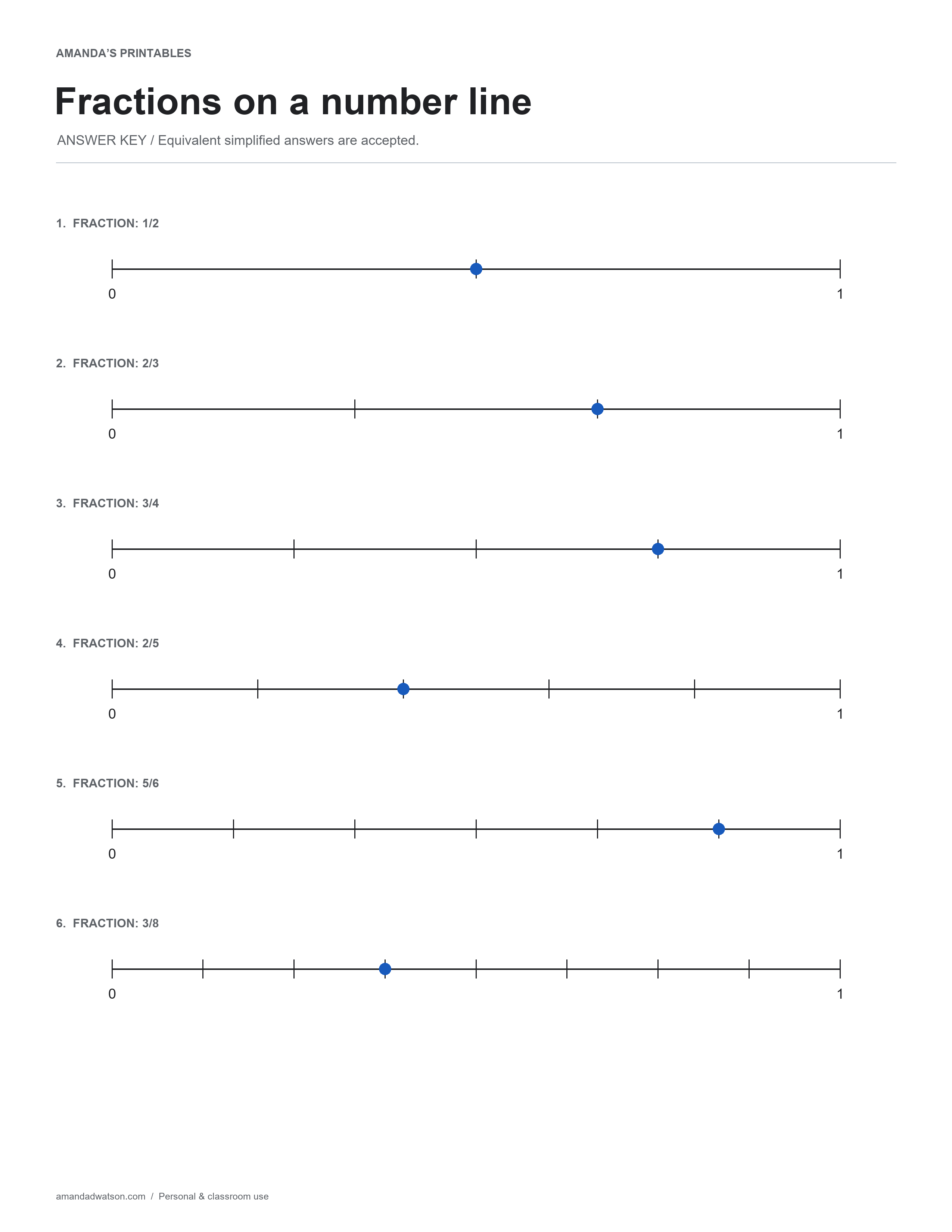
The key labels the marked fractions. A correct equivalent simplified fraction is also acceptable; the labels on the key preserve the original partitioning so the learner can connect the denominator to the visible intervals. Ask for a description of the point’s distance from zero as well as the written fraction.
This activity stays between zero and one. It does not introduce negative fractions or points beyond one whole. Use the fraction strips in the library alongside the page if comparing different representations would help the discussion.
Answers by line
- 1/2; simplified value: 1/2.
- 2/3; simplified value: 2/3.
- 3/4; simplified value: 3/4.
- 2/5; simplified value: 2/5.
- 5/6; simplified value: 5/6.
- 3/8; simplified value: 3/8.
Download and print
Use Download image beneath the printable for the original PNG. For a PDF, choose US Letter or A4 and select Download PDF; the website creates it from the image in your browser. Check the paper setting and print preview. These are flat printable pages, not fillable forms.
Print copies for personal and classroom use. When sharing online, link to the article rather than redistributing or reselling the files.