
Free Garden Seed Spacing Ratio Worksheet gives learners a diagram, one worked example and five questions. The student sheet leaves space to show work. A second printable page gives the steps for each answer.
Start with the model
Keep the relationship fixed by multiplying or dividing both quantities by the same number.
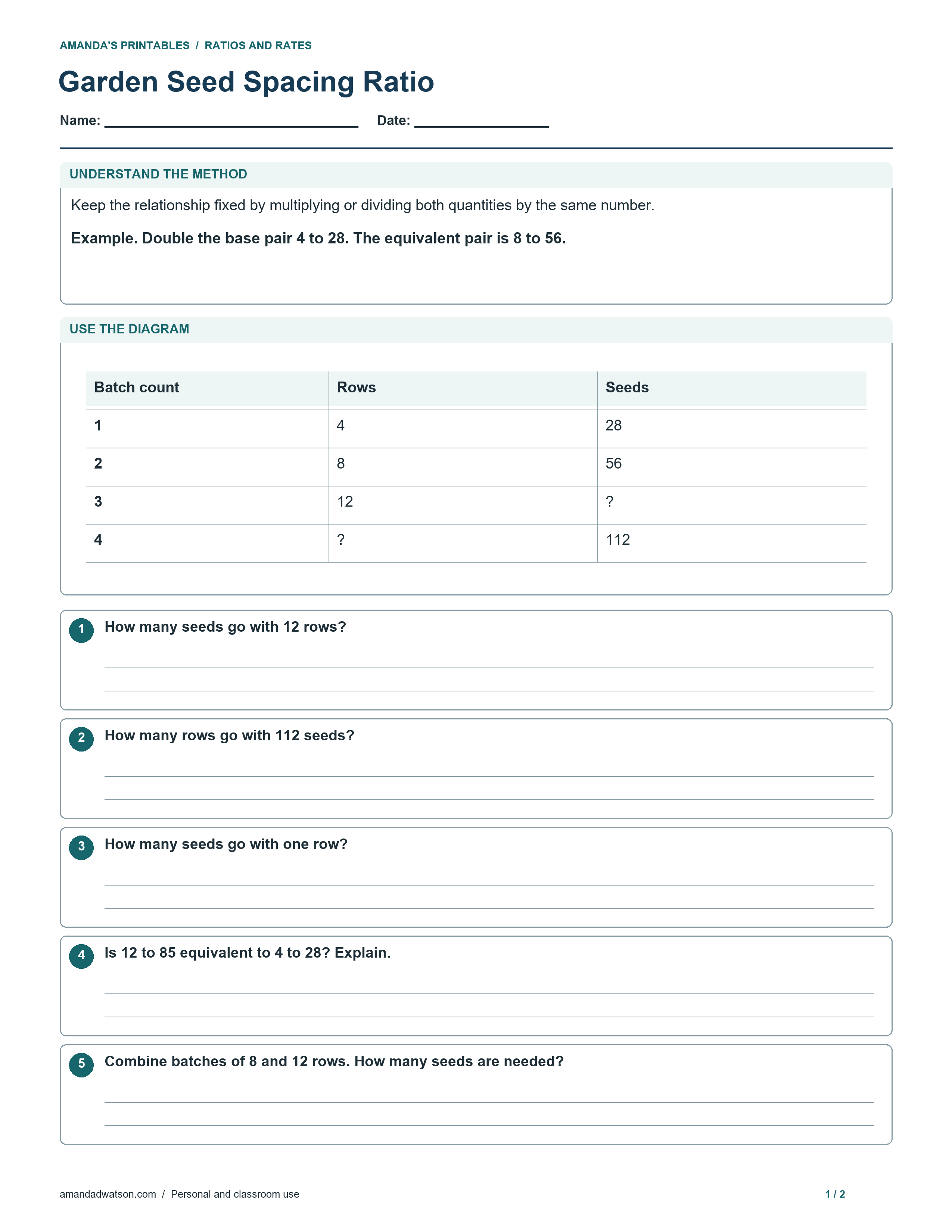
One batch pairs 4 rows with 28 seeds. The diagram shows a base pair, a doubled pair and two missing entries.
Worked example
Double the base pair 4 to 28. The equivalent pair is 8 to 56.
Ask the learner to point to the information used in the example. When they move on to the exercises, have them record the quantity, unit or label that each step represents.
Practice questions
- How many seeds go with 12 rows?
- How many rows go with 112 seeds?
- How many seeds go with one row?
- Is 12 to 85 equivalent to 4 to 28? Explain.
- Combine batches of 8 and 12 rows. How many seeds are needed?
Separate answer key
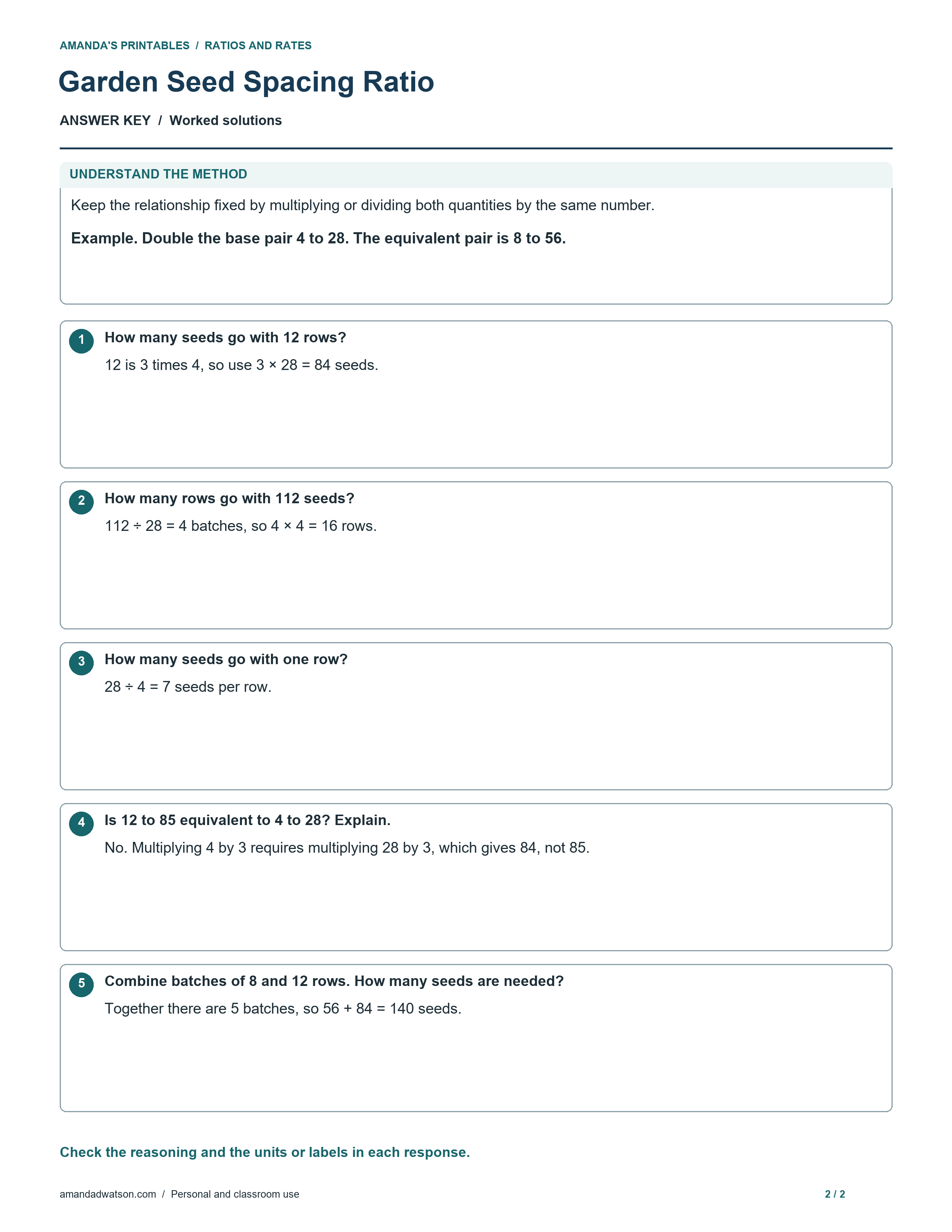
- 12 is 3 times 4, so use 3 × 28 = 84 seeds.
- 112 ÷ 28 = 4 batches, so 4 × 4 = 16 rows.
- 28 ÷ 4 = 7 seeds per row.
- No. Multiplying 4 by 3 requires multiplying 28 by 3, which gives 84, not 85.
- Together there are 5 batches, so 56 + 84 = 140 seeds.
Download the student sheet and key
Each page has its own Download image and Download PDF controls. Choose US Letter or A4 for the PDF. Match the paper size in the print dialog and check the page edges before printing. The original PNGs are 2550 × 3300 pixels at 300 dpi. The pages are free for personal and classroom use.