
This free printable helps learners use the 180-degree straight-angle rule, check a pair by addition and solve a simple one-part-to-two-parts challenge. It includes a complete student worksheet and a separate worked answer page, with original diagrams and checked solutions.
Who this worksheet suits
Learners should be comfortable subtracting whole numbers from 180. The first four problems use one known angle and one unknown angle. The final challenge invites a bar-model or verbal explanation, so formal algebra is optional.
What is on the student page
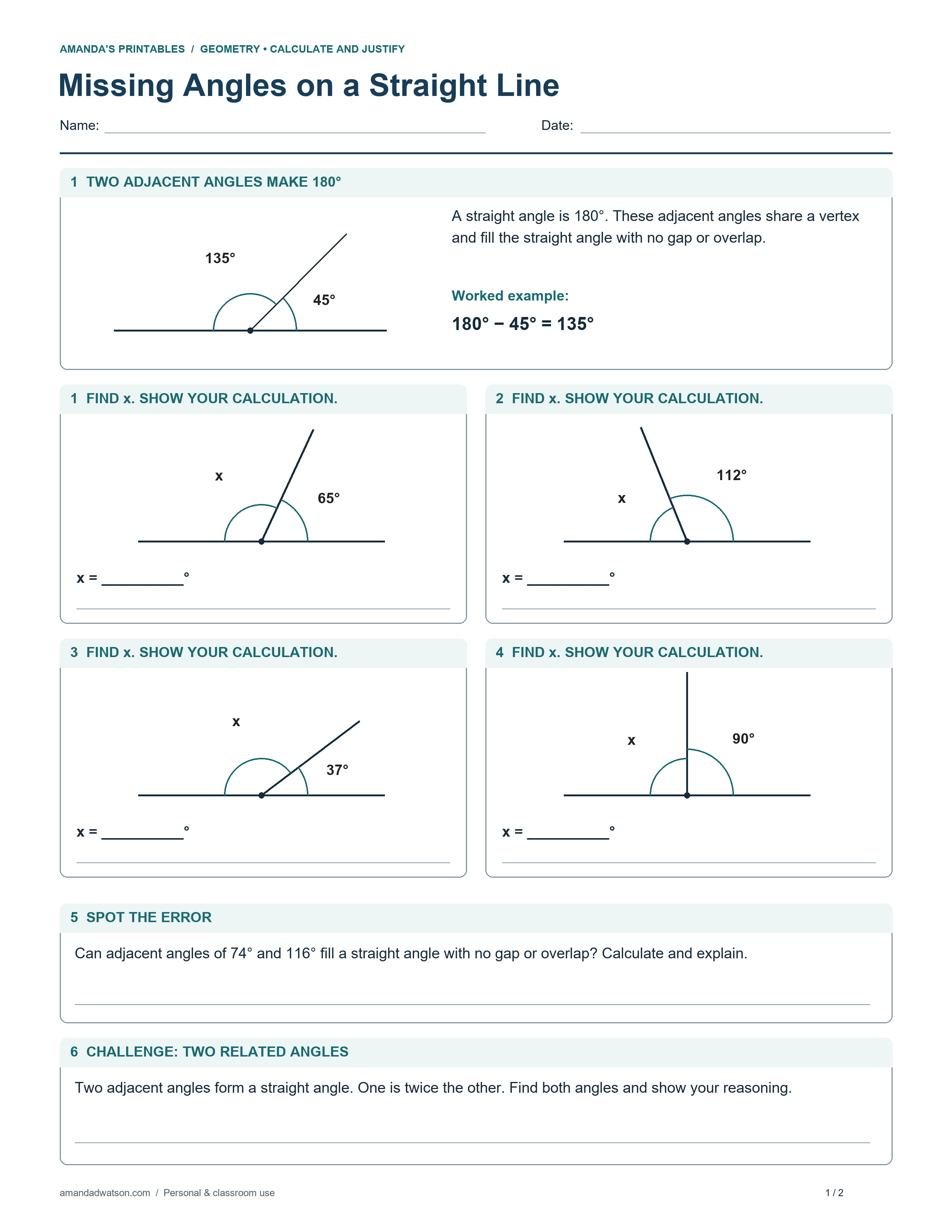
A worked pair of 45 and 135 degrees introduces the rule. Four diagrams then show different known angles, including an obtuse angle and a right angle. An error-analysis question tests a pair totaling 190 degrees. The last prompt gives a two-to-one relationship instead of a numerical known angle.
Teach the first example
Ask the learner to trace the straight baseline and identify the two adjacent angles above it. Explain that they fill the straight angle with no overlap or gap. Use subtraction to find the unknown, then add the pair as a check. Keep the written calculation beside each diagram.
Check a worked result
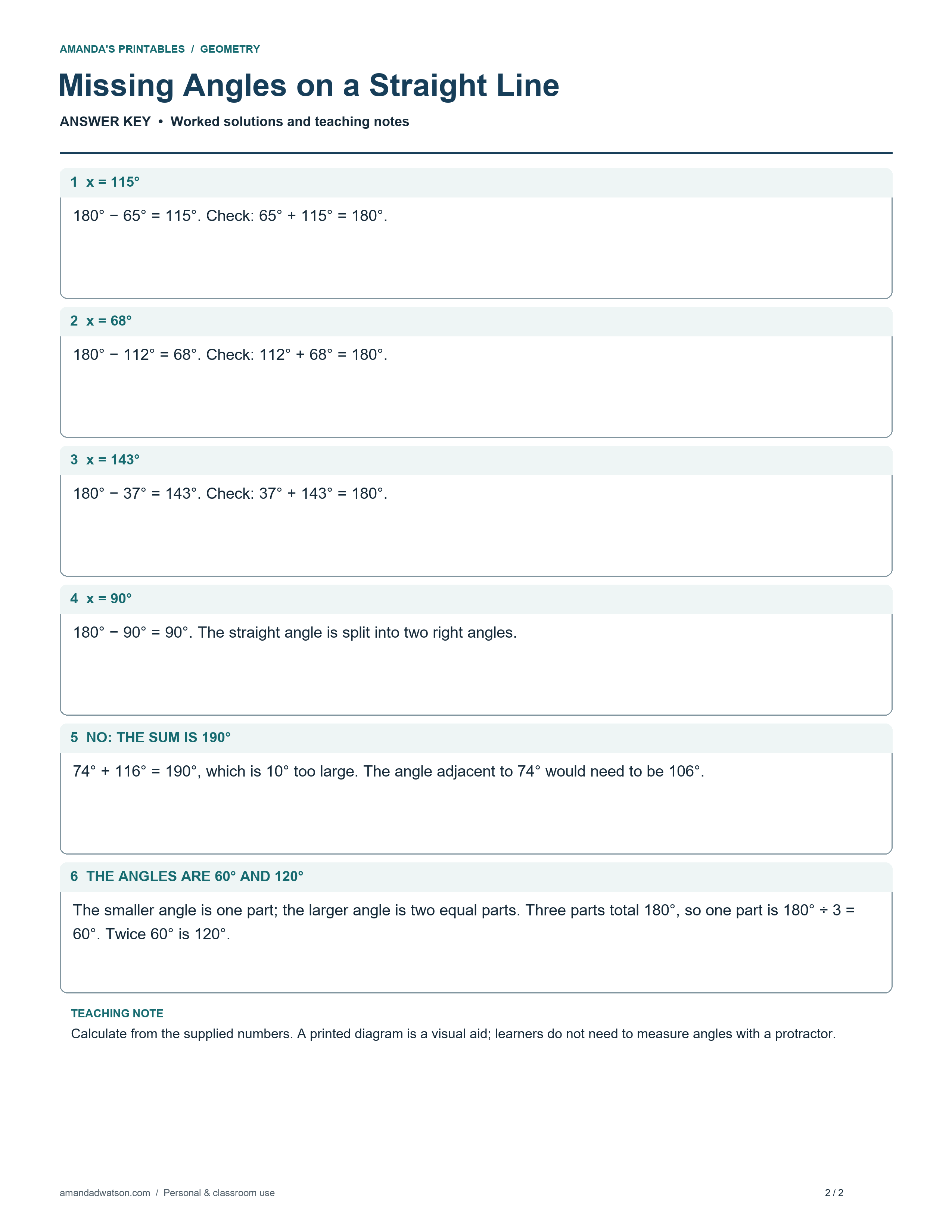
For a known angle of sixty-five degrees, subtracting from 180 gives an unknown of 115 degrees. In the challenge, the smaller angle is one equal part and the larger is two. Three parts make 180, so the angles are sixty and 120 degrees.
Common mistakes to discuss
Learners sometimes subtract from ninety instead of 180 or assume that the bigger-looking angle is always the unknown. Have them name the whole angle first. The 74-and-116 pair is useful for checking the rule because both numbers look plausible individually but their sum is ten degrees too large.
Worked answer key
Use the second page after an independent attempt. Compare the reasoning as well as the final answer. For explanation questions, equivalent clear wording is acceptable.
Download and print both pages
The supplied angle labels determine the answers. The drawings show the relationships, but no protractor is required. Print with uniform scaling and keep the answer page separate until the learner has explained at least one calculation. Use Download image beneath each page for its original 2550 × 3300 PNG at 300 dpi. Choose US Letter or A4 and Download PDF for that page. Download the student sheet and answer key separately. These are flat printables for handwriting, not interactive forms. Original pages are for personal and classroom use; share this article link when recommending them.