
Mosaic Strip Panels Distributive Arrays Worksheet gives learners a diagram, one worked example and five questions. The student sheet leaves space to show work. A second printable page gives the steps for each answer.
Start with the model
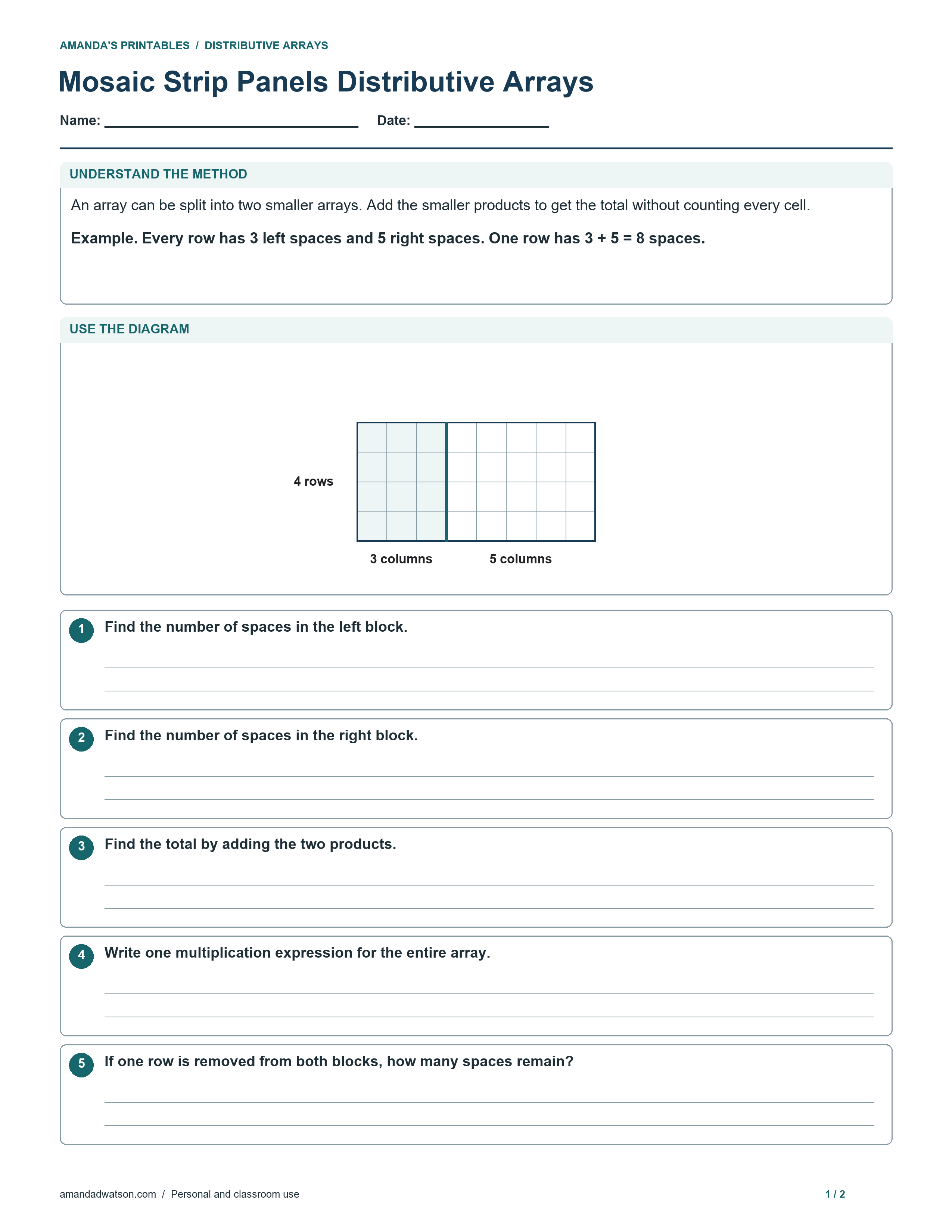
An array can be split into two smaller arrays. Add the smaller products to get the total without counting every cell.
The grid has 4 rows, 3 shaded columns on the left and 5 white columns on the right.
Worked example
Every row has 3 left spaces and 5 right spaces. One row has 3 + 5 = 8 spaces.
Ask the learner to point to the information used in the example. When they move on to the exercises, have them record the quantity, unit or label that each step represents.
Practice questions
- Find the number of spaces in the left block.
- Find the number of spaces in the right block.
- Find the total by adding the two products.
- Write one multiplication expression for the entire array.
- If one row is removed from both blocks, how many spaces remain?
Separate answer key
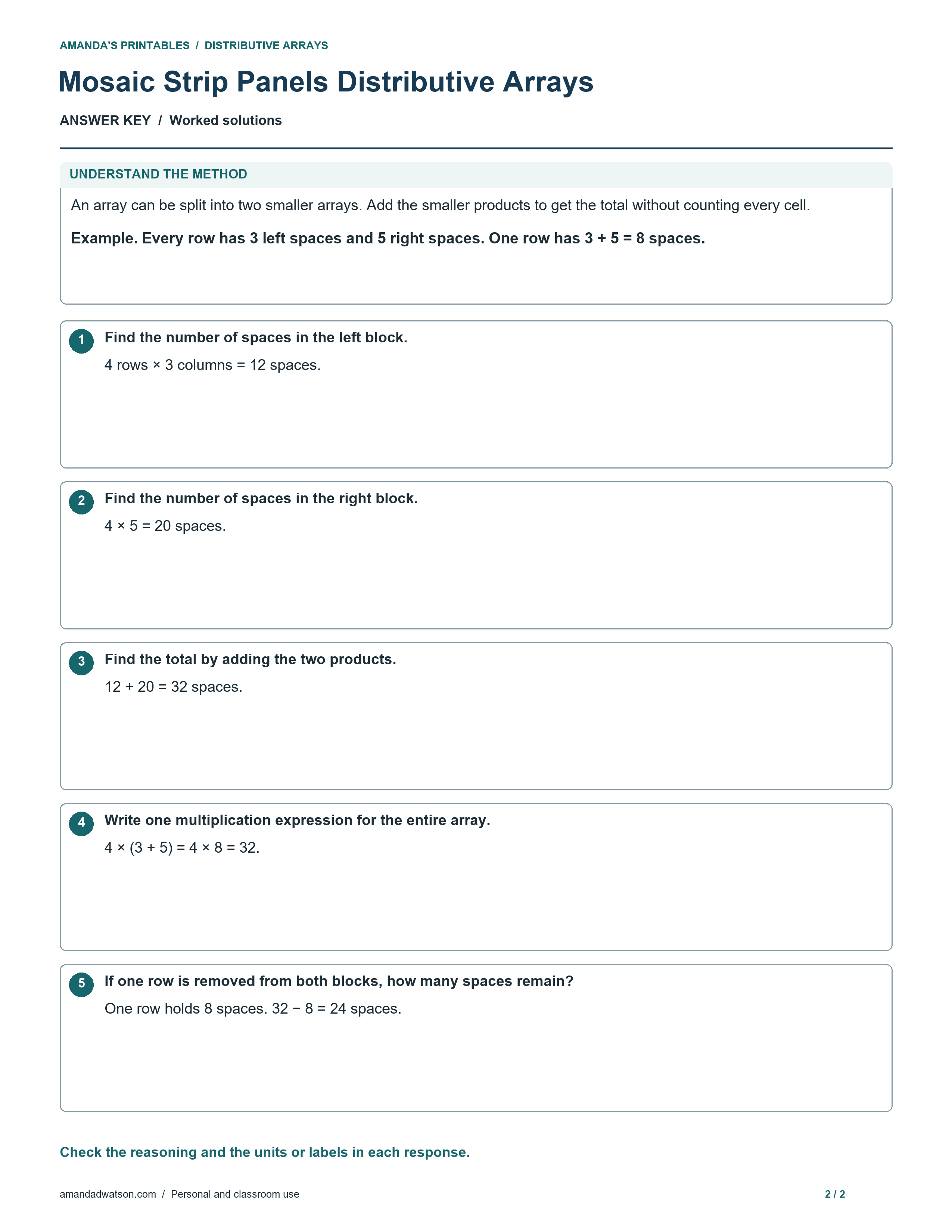
- 4 rows × 3 columns = 12 spaces.
- 4 × 5 = 20 spaces.
- 12 + 20 = 32 spaces.
- 4 × (3 + 5) = 4 × 8 = 32.
- One row holds 8 spaces. 32 − 8 = 24 spaces.
Download the student sheet and key
Each page has its own Download image and Download PDF controls. Choose US Letter or A4 for the PDF. Match the paper size in the print dialog and check the page edges before printing. The original PNGs are 2550 × 3300 pixels at 300 dpi. The pages are free for personal and classroom use.