
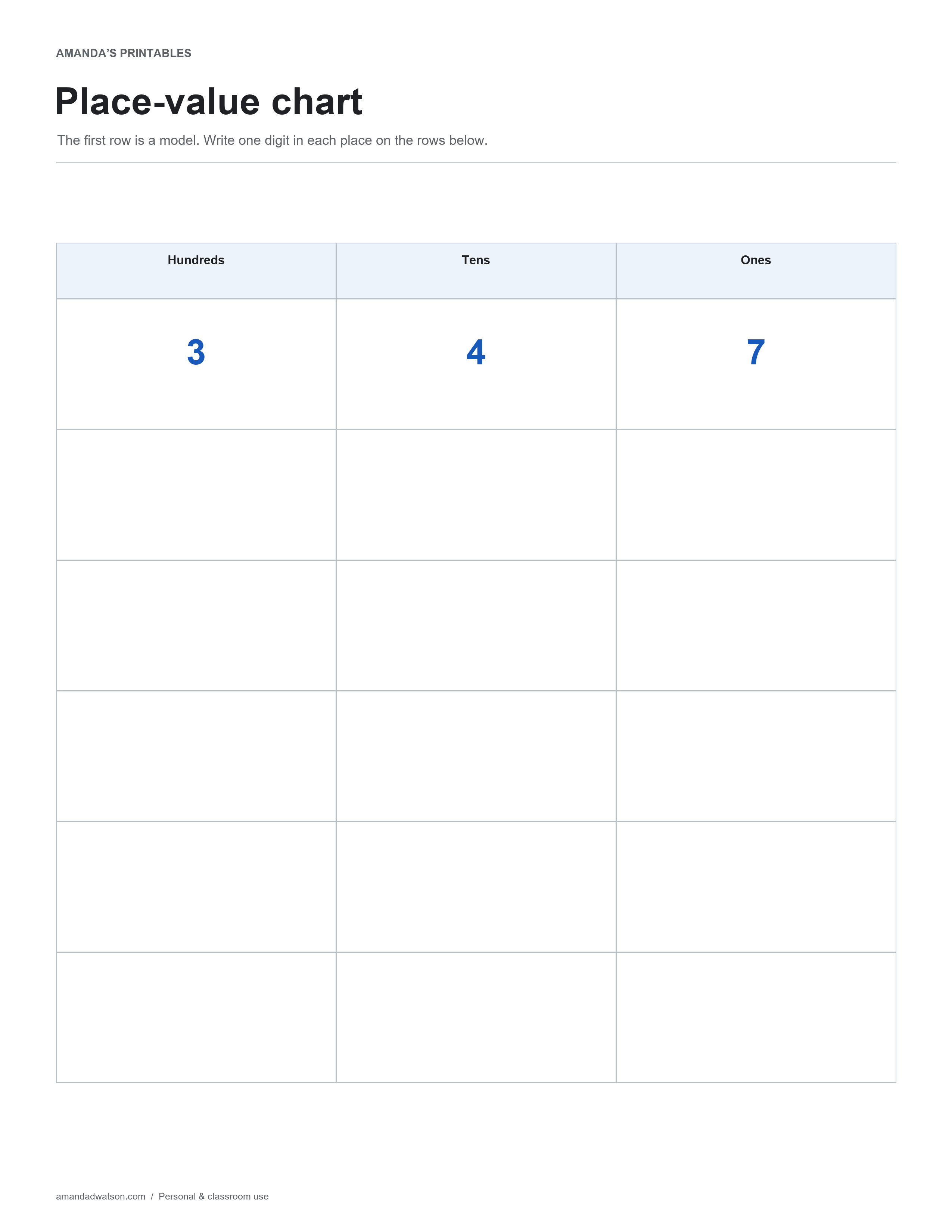
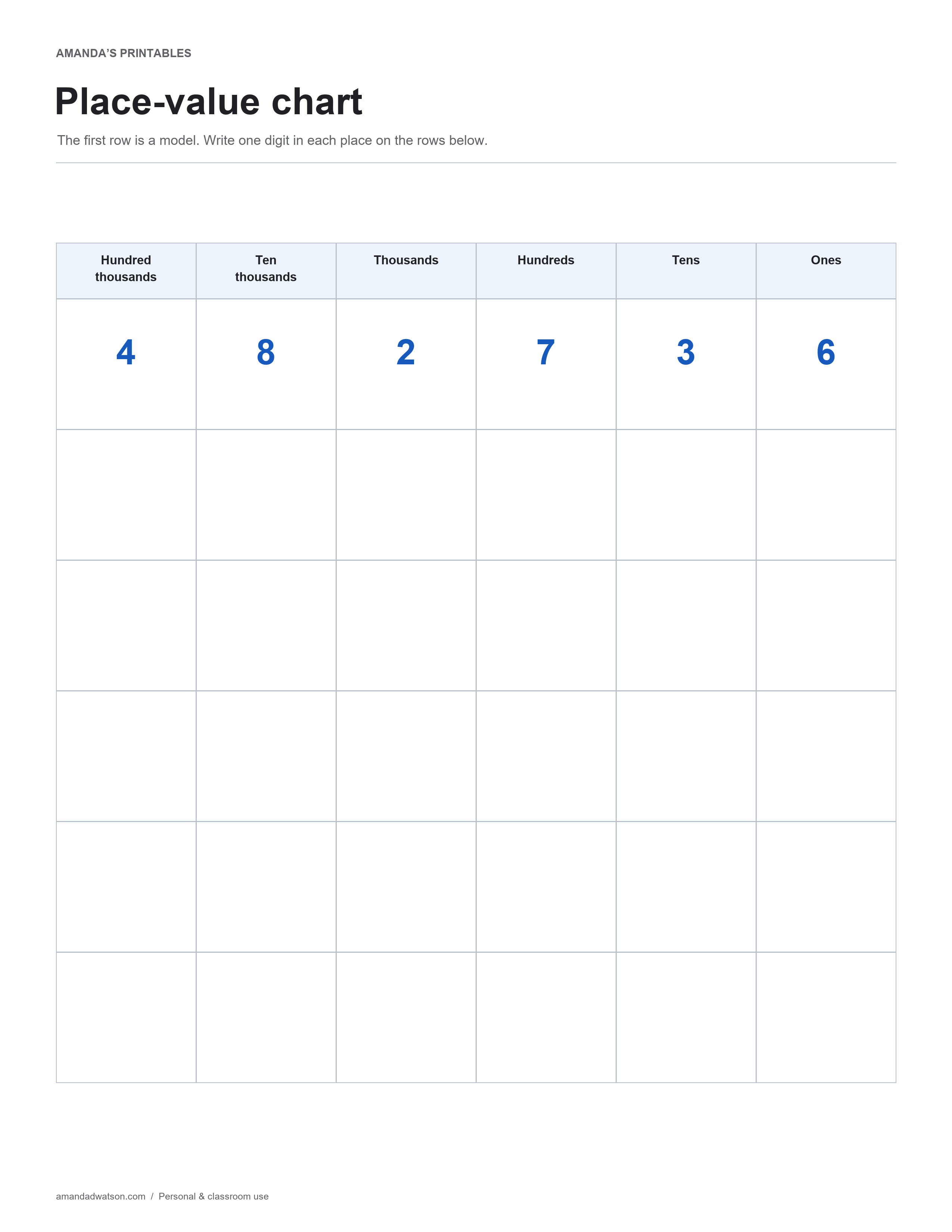
These printable place-value charts give each digit a labeled column. Choose a three-place chart for hundreds, tens, and ones, or a six-place chart that extends to hundred thousands. Each page starts with a model and has five blank rows underneath.
Hundreds, tens, and ones
The first chart shows 347 as its model. Read the columns as 3 hundreds, 4 tens, and 7 ones. Written as an expanded sum, that is 300 + 40 + 7.
Six whole-number places
The larger chart uses 482,736 as a model. Its places are hundred thousands, ten thousands, thousands, hundreds, tens, and ones. The expanded sum is 400,000 + 80,000 + 2,000 + 700 + 30 + 6.
Write one digit in each place
- Choose a number that fits the chart.
- Start with the ones digit in the rightmost column.
- Place the remaining digits in their columns, moving left.
- Read the number and explain the value of a selected digit.
For 305 on the three-place chart, the zero belongs in the tens column. It shows that there are no tens in that position; leaving it out would change the written number to 35.
Compare a digit with its value
In the model 347, the digit 4 has a value of 40 because it is in the tens place. The same digit in the hundreds place would have a value of 400. Each place to the left represents ten times the value of the neighboring place on its right.
These charts cover whole numbers only. They do not include a decimal point or places for tenths and hundredths. Use blank rows for your own examples rather than treating the page as a fixed problem set.
Download and print
Choose Download image beneath a printable to save its original PNG. If you prefer a PDF, select US Letter or A4 and let the website create a one-page file. Check the selected paper size and print preview before making several copies. These are flat printable images rather than fillable forms.
Print these original designs for personal and classroom use. When sharing the resource, link to the article rather than reselling or redistributing the files.