
Printable School Stage Layout on a Coordinate Grid Worksheet gives learners a diagram, one worked example and five questions. The student sheet leaves space to show work. A second printable page gives the steps for each answer.
Start with the model
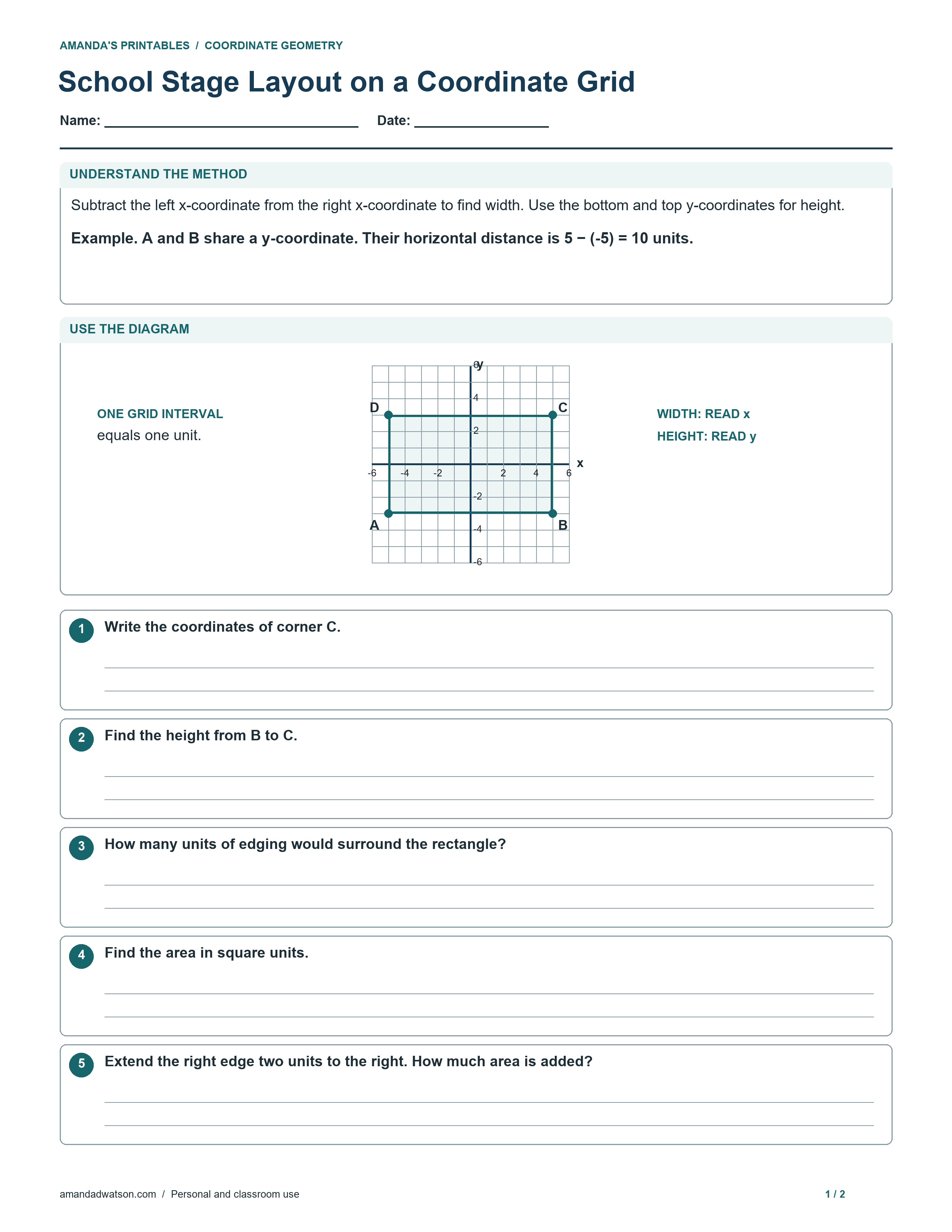
Subtract the left x-coordinate from the right x-coordinate to find width. Use the bottom and top y-coordinates for height.
Corners A (-5, -3), B (5, -3), C (5, 3) and D (-5, 3) form a rectangle.
Worked example
A and B share a y-coordinate. Their horizontal distance is 5 − (-5) = 10 units.
Ask the learner to point to the information used in the example. When they move on to the exercises, have them record the quantity, unit or label that each step represents.
Practice questions
- Write the coordinates of corner C.
- Find the height from B to C.
- How many units of edging would surround the rectangle?
- Find the area in square units.
- Extend the right edge two units to the right. How much area is added?
Separate answer key
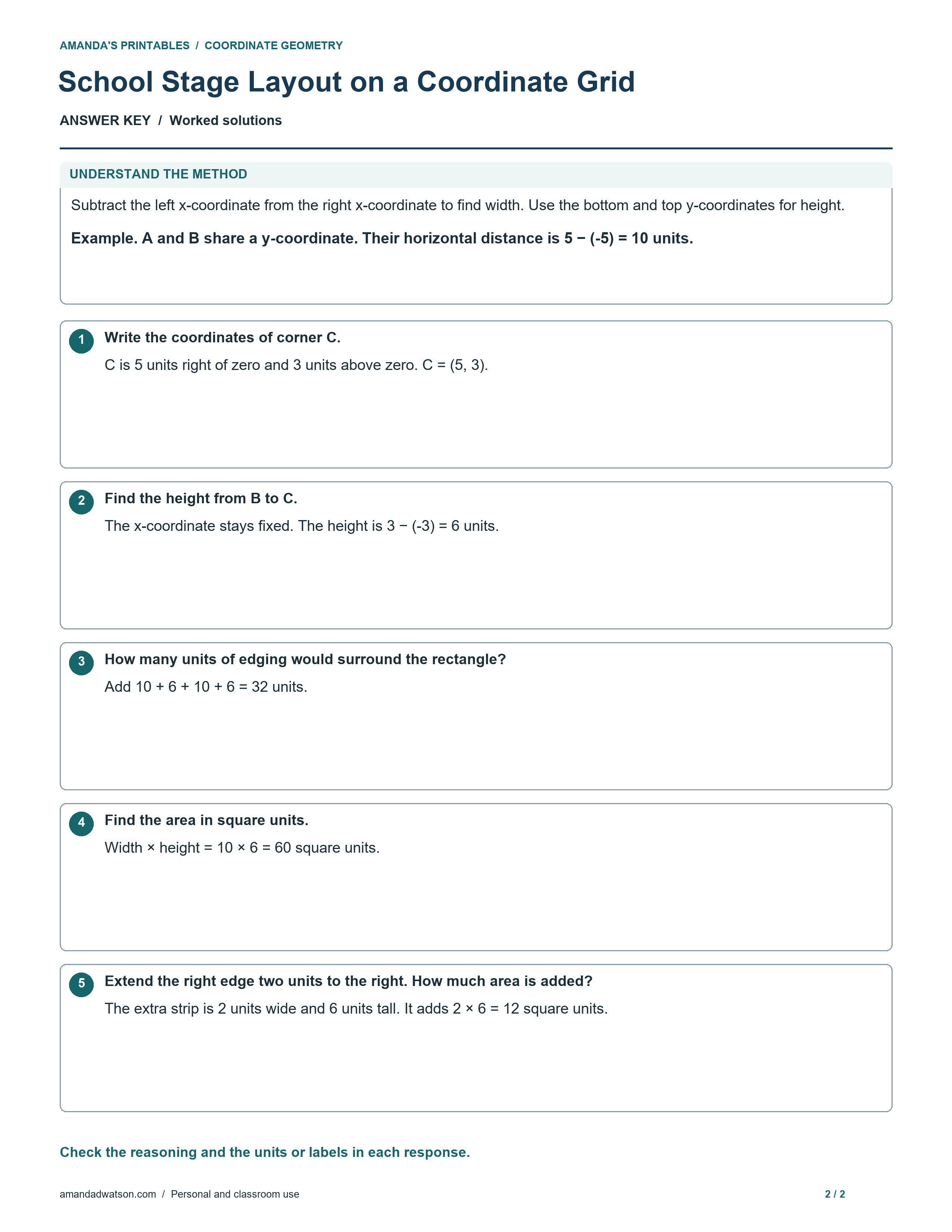
- C is 5 units right of zero and 3 units above zero. C = (5, 3).
- The x-coordinate stays fixed. The height is 3 − (-3) = 6 units.
- Add 10 + 6 + 10 + 6 = 32 units.
- Width × height = 10 × 6 = 60 square units.
- The extra strip is 2 units wide and 6 units tall. It adds 2 × 6 = 12 square units.
Download the student sheet and key
Each page has its own Download image and Download PDF controls. Choose US Letter or A4 for the PDF. Match the paper size in the print dialog and check the page edges before printing. The original PNGs are 2550 × 3300 pixels at 300 dpi. The pages are free for personal and classroom use.