
Garden Label Random Pairings Probability Tree Worksheet gives learners a diagram, one worked example and five questions. The student sheet leaves space to show work. A second printable page gives the steps for each answer.
Start with the model
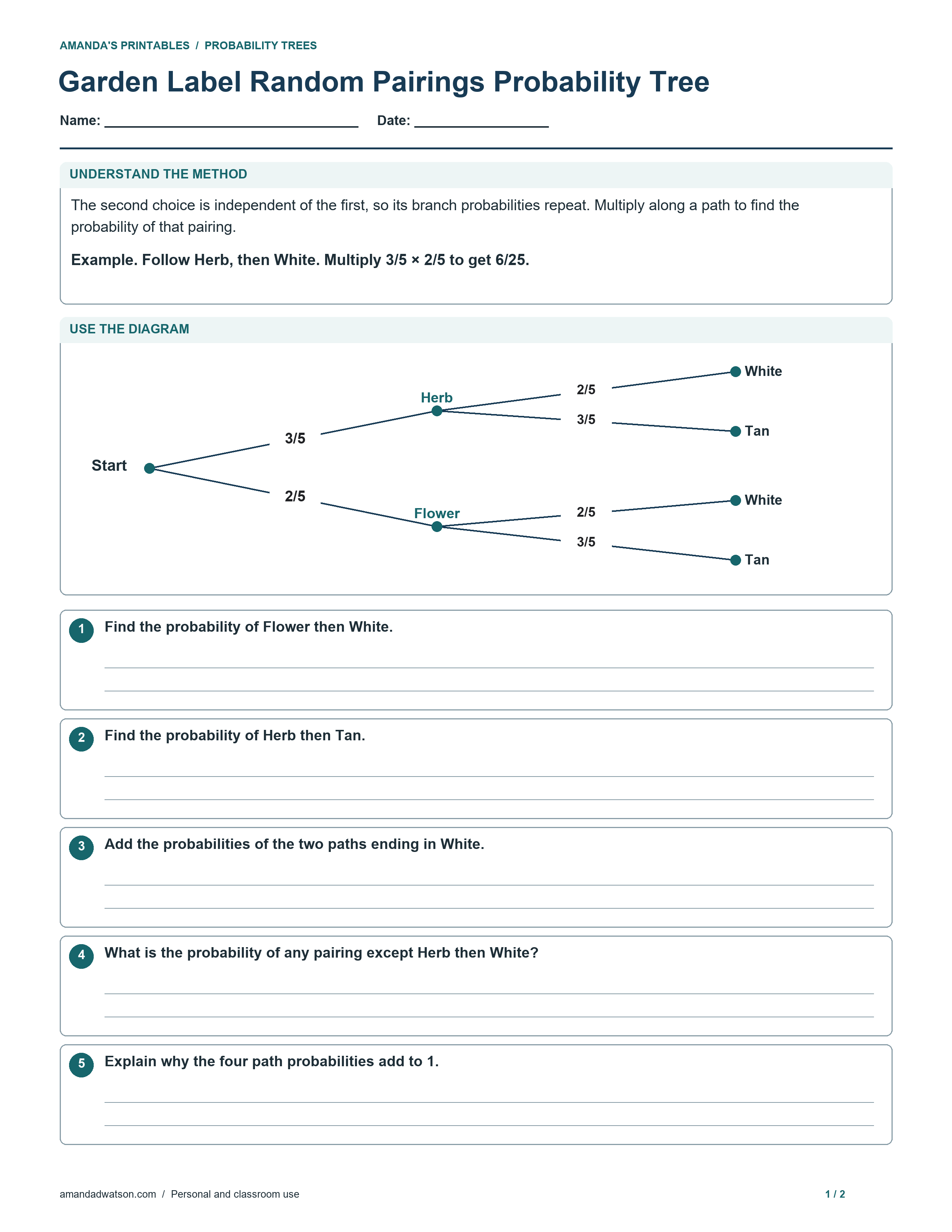
The second choice is independent of the first, so its branch probabilities repeat. Multiply along a path to find the probability of that pairing.
First choice: Herb (3/5) or Flower (2/5). Second choice: White (2/5) or Tan (3/5), regardless of the first choice.
Worked example
Follow Herb, then White. Multiply 3/5 × 2/5 to get 6/25.
Ask the learner to point to the information used in the example. When they move on to the exercises, have them record the quantity, unit or label that each step represents.
Practice questions
- Find the probability of Flower then White.
- Find the probability of Herb then Tan.
- Add the probabilities of the two paths ending in White.
- What is the probability of any pairing except Herb then White?
- Explain why the four path probabilities add to 1.
Separate answer key
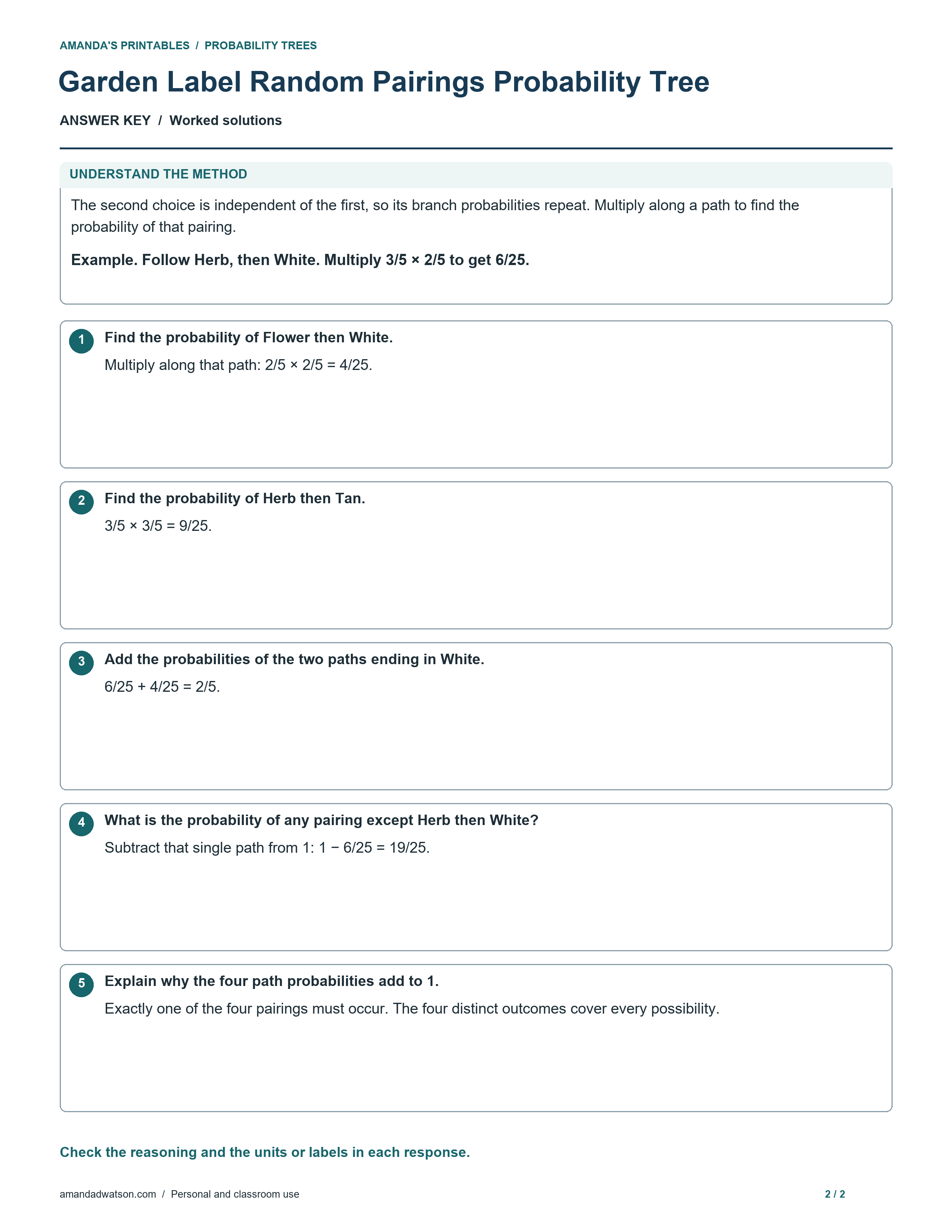
- Multiply along that path: 2/5 × 2/5 = 4/25.
- 3/5 × 3/5 = 9/25.
- 6/25 + 4/25 = 2/5.
- Subtract that single path from 1: 1 − 6/25 = 19/25.
- Exactly one of the four pairings must occur. The four distinct outcomes cover every possibility.
Download the student sheet and key
Each page has its own Download image and Download PDF controls. Choose US Letter or A4 for the PDF. Match the paper size in the print dialog and check the page edges before printing. The original PNGs are 2550 × 3300 pixels at 300 dpi. The pages are free for personal and classroom use.