
About this printable
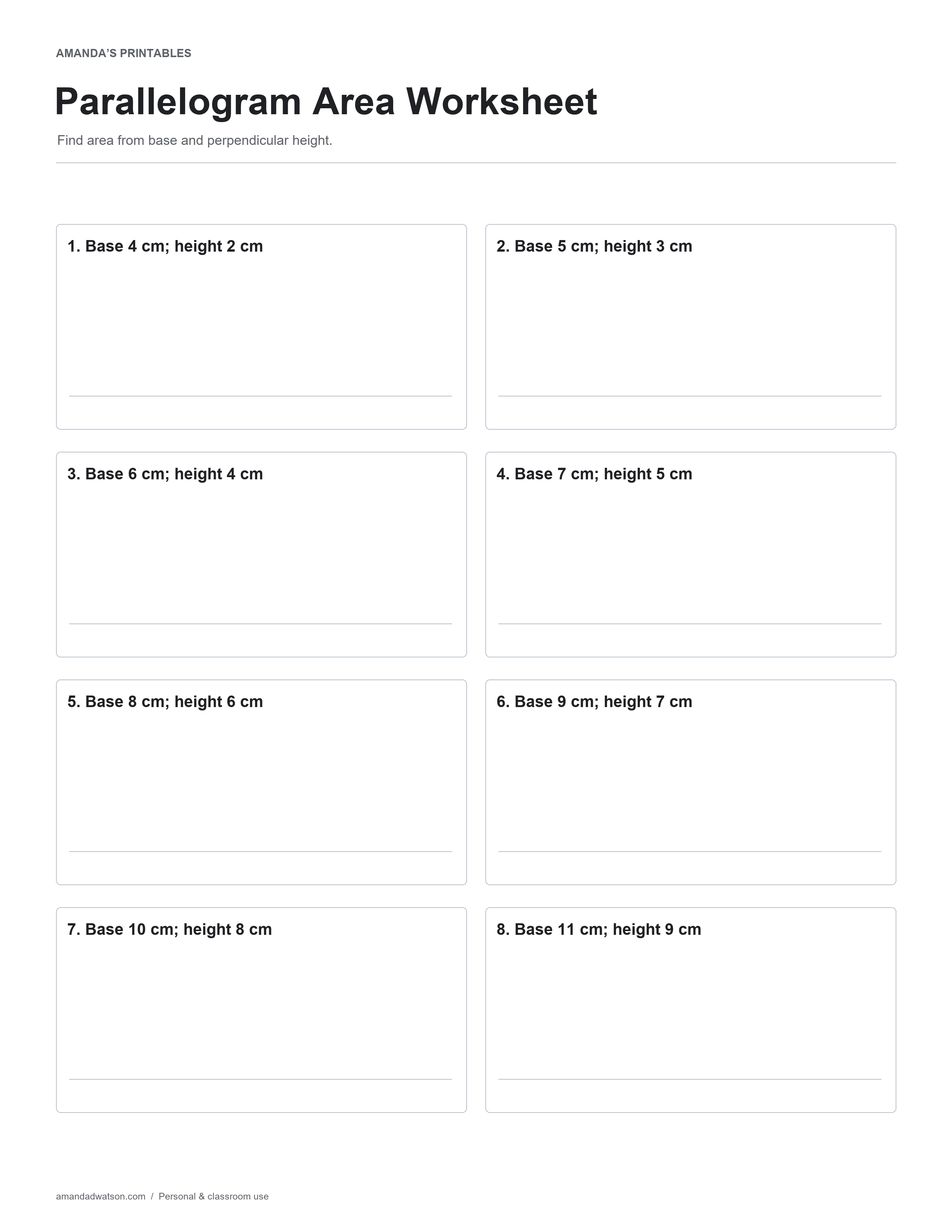
Practice parallelogram area with eight focused questions and a separate printable answer key. Each exercise has space for a written method, and the answers also appear as readable text below. Use the practice page first, then compare methods as well as final answers. The paired images stay together in this article so the solution can be found without searching for another post.
How to use it
Multiply the base by the perpendicular height to find a parallelogram area. A base of 8 cm and a perpendicular height of 5 cm give 40 square centimeters. The sloping side length is not automatically the height.
Check and adapt
Label the answer with square units and check that both measurements use the same unit. Each prompt explicitly supplies perpendicular height. These are numerical practice questions; no diagram is drawn to scale and no angle measurement is needed.
Answers in text
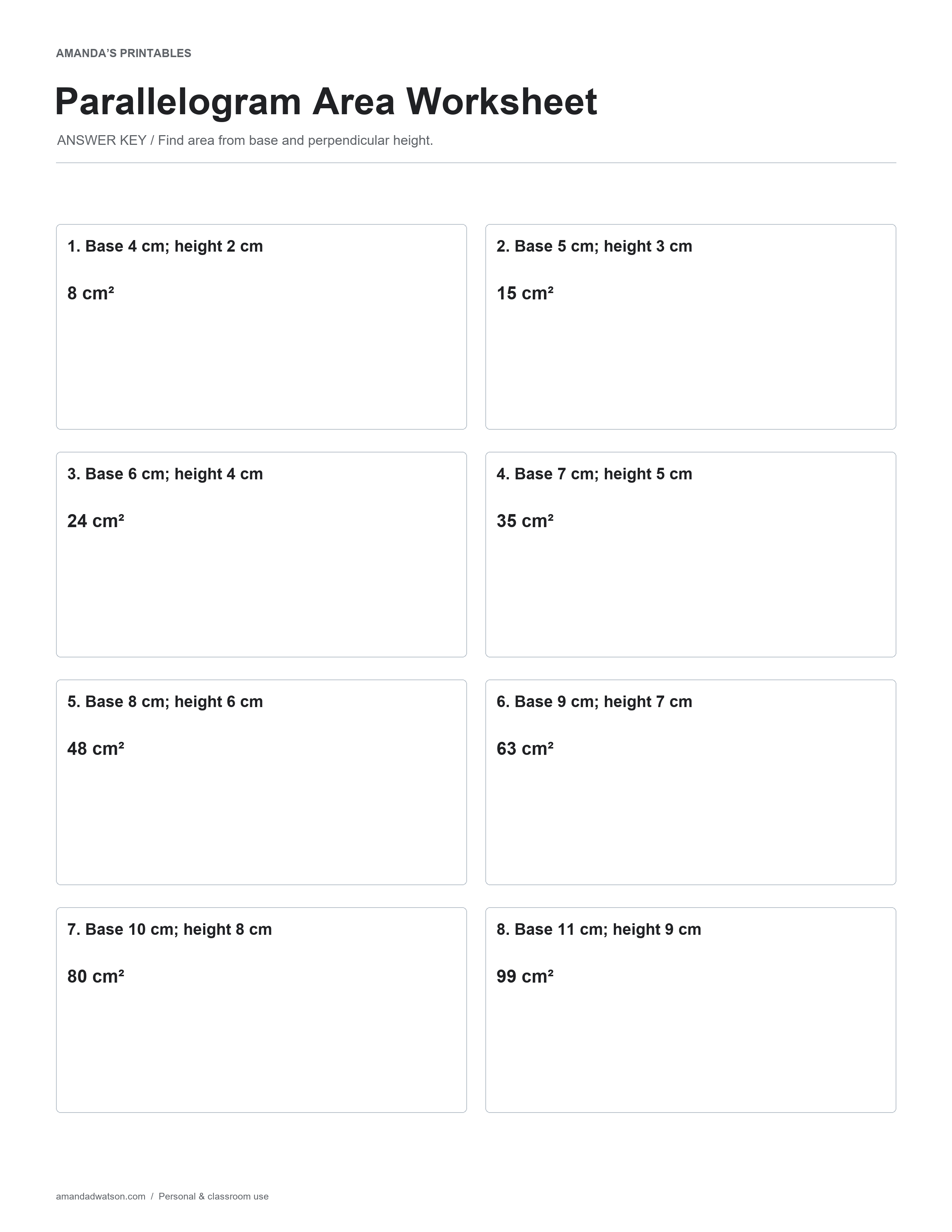
- Base 4 cm; height 2 cm: 8 cm².
- Base 5 cm; height 3 cm: 15 cm².
- Base 6 cm; height 4 cm: 24 cm².
- Base 7 cm; height 5 cm: 35 cm².
- Base 8 cm; height 6 cm: 48 cm².
- Base 9 cm; height 7 cm: 63 cm².
- Base 10 cm; height 8 cm: 80 cm².
- Base 11 cm; height 9 cm: 99 cm².
Printable answer key
Download and printing instructions
Use Download image to save the original high-resolution PNG. To make a PDF, choose US Letter or A4 below the image and select Download PDF. The website creates that file in your browser; no separate PDF attachment is needed. Match the printer paper setting to your choice, use uniform scaling and check that every edge fits inside the printable area. Print one test copy before making a classroom set. These are flat printable pages, not editable forms. Originals are for personal and classroom use; share the article link rather than redistributing the files.